
Selecting the right supplier for hotel bathroom hardware is no longer a simple price comparison. In 2026, owners must balance durability, design consistency, water efficiency, lead times, and after-sales support. Hotel Bathroom Hardware Custom solutions can help properties match faucets, shower sets, towel bars, robe hooks, and accessories to a specific guestroom concept. The details matter. A brushed brass finish should remain consistent beside a stone vanity, while a concealed shower valve must allow practical maintenance access.
Industry data supports this more demanding approach. Lodging Econometrics’ 2025 hotel construction pipeline reports continued global development activity, creating steady demand for standardized bathroom packages and dependable production capacity. The American Hotel & Lodging Association’s 2025 industry outlook also highlights ongoing operating-cost pressure across hotels. That pressure makes lifecycle value more important than the lowest purchase price. A cheaper handle can become expensive when plating fails, replacement parts disappear, or installation requires repeated adjustments.
Professional buyers should examine factory audits, material certificates, testing procedures, warranty terms, and project references. They should also confirm compliance with applicable plumbing, accessibility, and water-efficiency requirements in each target market. Reports from the U.S. Environmental Protection Agency’s WaterSense program show why efficient fixtures remain commercially relevant, especially in properties with many bathrooms and high daily occupancy. Yet data alone cannot select a supplier. Sample inspection still reveals uneven polishing, sharp edges, weak threads, and color variation.
No supplier is perfect. Specifications may change, and real installation conditions can expose overlooked problems. A reliable sourcing process therefore includes physical samples, pilot-room testing, documented approvals, and clear communication from design to delivery. This guide examines leading custom suppliers through that practical, evidence-based lens.
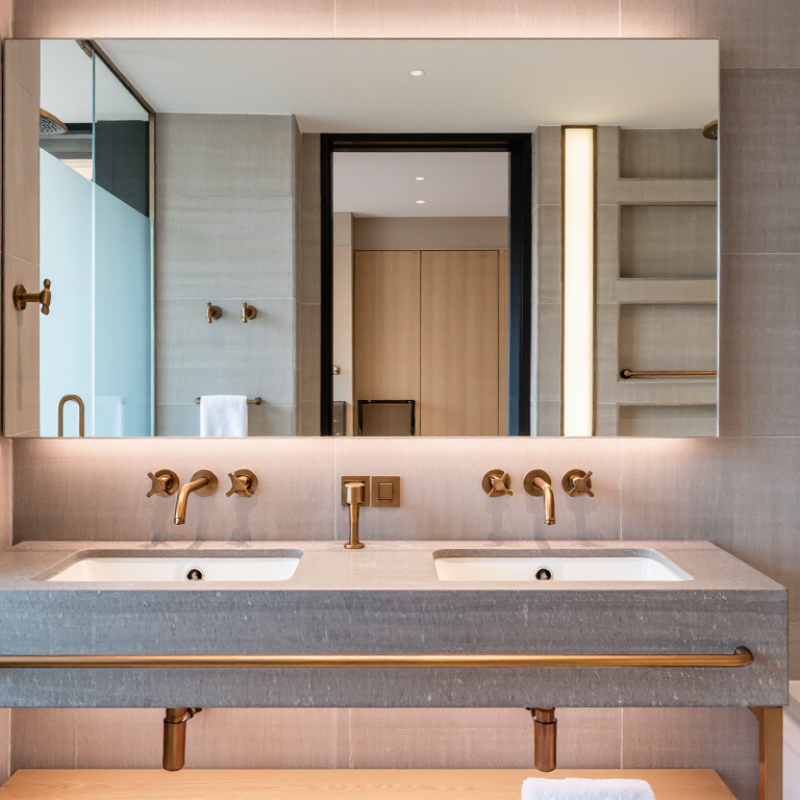
In 2026, a custom hotel bathroom hardware supplier does more than copy a drawing. The supplier studies room layouts, cleaning routines, guest traffic, and local installation habits. A towel bar beside a wet shower may look attractive, yet become a maintenance problem. Experienced suppliers test details through samples, mock-up rooms, and feedback from housekeeping teams. They ask uncomfortable questions about corrosion, loose fixings, sharp edges, and replacement access. That practical attention separates customization from simple private labeling.
Professional expertise appears in measurable processes. A capable supplier can develop CAD files, finish samples, load tests, and installation guides for each project. They should explain material grades, coating performance, tolerances, and expected service life without vague promises. Documentation matters when designers, contractors, and hotel operators work across different countries. Reliable suppliers also provide traceable production records, inspection photos, packaging checks, and realistic lead times. One missing screw can delay an entire bathroom handover.
Authority comes from verified performance, not polished brochures. Look for relevant testing, transparent quality controls, and references from comparable hospitality projects. Communication should remain clear after the purchase order, especially when dimensions change. A good supplier will admit when a requested finish may fail under aggressive cleaning chemicals. That honesty builds trust, although it can slow the design process. Beautiful hardware is sometimes specified too early, then revised after installation feedback. Custom work needs room for correction. The best partnership leaves a clear trail from prototype to replacement part.

The chart presents a practical 100-point procurement framework for evaluating custom hotel bathroom hardware suppliers. Customization, corrosion resistance, quality compliance, and delivery reliability carry the greatest weight because they directly affect hotel design consistency, lifecycle performance, and project schedules.
Scoring basis: weighted evaluation model totaling 100 points. Higher values indicate greater importance during hotel procurement and supplier qualification.
2026 Best Custom Hotel Bathroom Hardware Suppliers?
Selecting a supplier requires more than comparing finish samples. Start with material certificates, coating specifications, and corrosion-test results. For humid hotels, 316 stainless steel often offers stronger chloride resistance than ordinary stainless steel. Solid brass can provide useful weight and stability, but its protective finish still needs verification.
I ask suppliers for production samples, not only showroom pieces. A 2024 J.D. Power North America Hotel Guest Satisfaction Index Study continues to identify cleanliness and maintenance as important satisfaction dimensions. Hardware should therefore have concealed joints, smooth edges, and replaceable components. The U.S. EPA WaterSense program reports that certified bathroom faucets use no more than 1.5 gallons per minute, at least 20% less than standard models. That supports water-conscious hotel specifications.
Design customization should cover mounting holes, projection, handle shape, finish, and accessibility. The Global Wellness Institute’s 2024 Global Wellness Economy Monitor valued the wellness economy at $6.3 trillion in 2023, strengthening demand for calm, spa-like bathrooms. Still, customization can create maintenance problems. I would request a full-size mock-up and cleaning-cycle test before approving production. A beautiful finish may fail under chlorine exposure. I have seen specifications miss this detail. Supplier reliability also depends on batch consistency, documented inspection, replacement lead times, and a realistic warranty. “Custom” sounds impressive, but repeatable quality matters more.
A practical comparison framework for evaluating material performance, design flexibility, finishing quality, and customization capability.
| Evaluation Dimension | Recommended Requirement | 304 Stainless Steel | 316 Stainless Steel | Solid Brass | Zinc Alloy | Assessment Method |
|---|---|---|---|---|---|---|
| Corrosion Resistance | Select a grade and finish suitable for high humidity, cleaning chemicals, and coastal exposure where applicable. | Very good for general hotel bathrooms; suitable for most inland environments. | Excellent chloride resistance; preferred for coastal or salt-air locations. | Good when properly lacquered or plated; exposed surfaces require maintenance. | Moderate; highly dependent on substrate preparation and coating quality. | Request salt-spray results, coating specifications, and samples exposed to hotel cleaning products. |
| Mechanical Strength | Prioritize rigid construction, secure anchors, and adequate wall reinforcement for frequently used accessories. | High strength and good resistance to impact and deformation. | High strength; appropriate for heavy-use and premium installations. | Strong and rigid; heavier than many alternative materials. | Adequate for light-to-medium duty; may be more vulnerable to impact damage. | Review load testing, mounting hardware, wall-anchor compatibility, and cycle-test results. |
| Finish Durability | The finish should resist scratching, peeling, staining, water spots, and repeated cleaning. | Brushed or polished surface can perform well; PVD and electroplated finishes add design choices. | Supports durable brushed, polished, plated, and PVD finishes. | Accepts plating and protective lacquer effectively when process control is consistent. | Can achieve many colors and textures, but coating adhesion is critical. | Ask for coating thickness, adhesion testing, abrasion testing, and care instructions. |
| Customization Scope | The supplier should support project-specific dimensions, finishes, mounting systems, and packaging. | Strong option for precision profiles, concealed fixing, laser marking, and bespoke dimensions. | Suitable for high-end custom details and demanding environmental specifications. | Well suited to cast shapes, decorative profiles, engraved details, and custom color matching. | Efficient for complex shapes and cost-sensitive customized designs. | Confirm drawing approval, prototype process, tooling ownership, minimum order quantity, and change-control procedure. |
| Manufacturing Tolerance | Critical interfaces should be dimensionally controlled to ensure consistent installation across rooms. | Machined and formed parts can achieve tight, repeatable dimensions. | Comparable precision potential; machining may increase cost and lead time. | Good dimensional control through machining, forging, or casting plus finishing. | Casting tolerances may require secondary machining on critical surfaces. | Request approved drawings, inspection plans, first-article samples, and dimensional reports. |
| Hygiene and Maintenance | Use smooth, sealed surfaces with minimal dirt traps and clear cleaning guidance. | Non-porous and easy to clean; brushed textures can hide light water marks. | Non-porous and suitable for frequent cleaning in demanding environments. | Easy to maintain when the protective surface remains intact. | Easy to clean, but damaged coatings can expose the base metal. | Evaluate radiused edges, drainage, concealed joints, cleaning compatibility, and replacement access. |
| Typical Cost Position | Compare total installed cost rather than unit price alone. | Mid-range to premium, depending on grade, fabrication, and finish. | Premium due to alloy content and enhanced corrosion performance. | Mid-range; often economical for substantial decorative hardware. | Generally cost-effective for decorative and medium-duty applications. | Include tooling, sampling, testing, freight, installation, spare parts, and lifecycle maintenance. |
| Quality Documentation | Documentation should allow material, finish, and production consistency to be verified. | Request material certificates confirming the stainless-steel grade and applicable test reports. | Request grade verification, corrosion test data, and traceability records. | Request alloy composition, plating process details, and surface inspection records. | Request base-metal composition, coating adhesion data, and casting inspection records. | Verify certificates against the approved sample and require batch-level inspection records. |
Note: Performance varies with alloy composition, manufacturing process, surface treatment, installation, and cleaning chemicals. Confirm project-specific requirements with technical documentation and physical samples.
For the 2026 best custom hotel bathroom hardware suppliers, certifications should support real manufacturing evidence. ISO 9001 shows that a supplier controls design, production, inspection, and corrective actions. Request the current certificate, scope, and audit details. A certificate covering office management is not enough.
Water-contact products need closer review. Faucets and shower fittings should meet applicable plumbing standards, such as ASME A112.18.1 or CSA B125.1. Materials may also require NSF/ANSI/CAN 61 or local lead-content compliance. Requirements differ by destination market. Confirm them before placing a large order. Ask for laboratory reports, batch traceability, and documented material declarations.
Performance testing should match hotel conditions. Look for pressure testing, cartridge cycle testing, flow-rate checks, and corrosion testing. ASTM B117 salt-spray results can help evaluate finishes, but salt spray does not perfectly predict bathroom life. That limitation matters. For exposed hardware, inspect coating thickness, adhesion, edge coverage, and color consistency. Request pre-production samples and compare them under warm lighting. Small defects become obvious beside marble and polished stone.
Environmental systems may add value when they are verified. ISO 14001 can indicate structured environmental management, while ISO 45001 supports workplace safety controls. Neither standard guarantees excellent hardware. Factory visits, independent inspections, and retained samples remain important. No checklist is flawless. A supplier may pass paperwork reviews yet miss a weak thread or leaking seal. Reliable sourcing combines certificates, testing, production records, and honest discussion of failure risks.
Price comparisons should begin with one identical specification sheet. Include alloy grade, finish thickness, mounting method, packaging, testing, and replacement parts. A cheaper quotation often excludes tooling, sampling, or inspection costs. Deloitte’s 2024 Global Chief Procurement Officer Survey identifies cost management and supply continuity as leading procurement priorities. That matches what hotel projects experience daily.
Lead time needs a written production calendar. Request dates for drawing approval, tooling, first samples, mass production, inspection, and shipment. Deloitte’s 2024 Engineering and Construction Industry Outlook continues to highlight labor shortages, material-price pressure, and supply-chain disruption. For bathroom hardware, ask whether the supplier holds raw materials or buys them after receiving your order. That small detail can change delivery by several weeks.
Production capability should be proven, not promised. Review factory capacity, monthly output, finishing equipment, quality records, and recent hospitality references. Ask for a live video audit or an independent inspection report. I usually compare landed cost, not unit price. Freight, duties, defects, and late-installation labor matter. The World Bank’s Commodity Markets Outlook also shows continuing uncertainty in industrial material pricing. I would not pretend every forecast is reliable. A supplier with excellent samples may still lack stable volume production. Build a pilot order into the decision, then measure defects and actual lead time before approving the full hotel package.
Choosing the right supplier starts with project fit, not a polished catalog. Confirm the supplier’s experience with hotel bathrooms, repeated cleaning, humidity, and high guest turnover. Request material certificates, coating specifications, corrosion-test results, and production samples. A real sample matters more than a digital rendering. Check whether hinges, towel bars, faucets, and dispensers share consistent finishes. Small mismatches become obvious under bright bathroom lighting.
Water performance also deserves measurable scrutiny. The U.S. Environmental Protection Agency states that WaterSense-labeled bathroom products use at least 20% less water than standard models, while maintaining comparable performance. The supplier should provide flow-rate data and independent test documents. The United Nations Environment Programme’s 2024 Global Status Report says buildings consume about 32% of global energy and produce 34% of global carbon emissions. Efficient hardware cannot solve every sustainability problem. It can still reduce daily waste across hundreds of rooms. Ask for lifecycle evidence, not vague green language.
Your evaluation should include lead times, replacement parts, installation drawings, and after-sales response. Ask how quickly a damaged hinge or cartridge can be replaced in a remote property. Review the warranty exclusions carefully. They often reveal more than the headline warranty period. A pilot installation in one bathroom is wise. It may expose awkward mounting holes, weak packaging, or a finish that scratches too easily. No checklist is perfect. I would still score technical evidence, service capacity, customization control, and total installed cost before approving a supplier.
Content © 2025 Komatsu. All Rights Reserved