three part picture of forklifts

2026 Best Solar Light Tower for Global Buyers

Choosing the 2026 best Solar Light Tower requires more than comparing brightness or battery capacity. Global buyers need dependable illumination for construction sites, road maintenance, emergency response, mining, agriculture, and outdoor events. The right tower must perform under changing weather, transport limits, and different electrical standards. It should also reduce fuel use without creating difficult maintenance demands.

Fatih Birol, Executive Director of the International Energy Agency, has said, “The world is at the beginning of the solar age.” His observation gives this market wider context. Solar energy is becoming more practical, but a Solar Light Tower still depends on engineering details. Panel efficiency matters. Battery chemistry matters. So do mast stability, lamp coverage, charging time, noise levels, and spare-parts access. Small design choices become obvious at 2 a.m. on a wet worksite.

Real purchasing experience also exposes uncomfortable gaps. Some products advertise long runtimes under ideal sunlight, yet provide weaker results in winter or dusty regions. Marketing figures can be optimistic. Very optimistic. Buyers should request independent test data, lighting diagrams, warranty terms, and service contacts before ordering. IP ratings, wind resistance, battery temperature control, and controller quality deserve careful review. A tower that looks impressive in a showroom may struggle on uneven ground.

This guide compares leading Solar Light Tower solutions for international buyers in 2026. It considers operating cost, portability, safety, durability, illumination performance, and regional support. No single model wins everywhere. A compact tower may suit a temporary project, while a larger hybrid unit may serve remote infrastructure work. The best choice is the one that remains useful after the brochure promises fade.
2026 Best Solar Light Tower for Global Buyers

What Is a Solar Light Tower and How Does It Work?

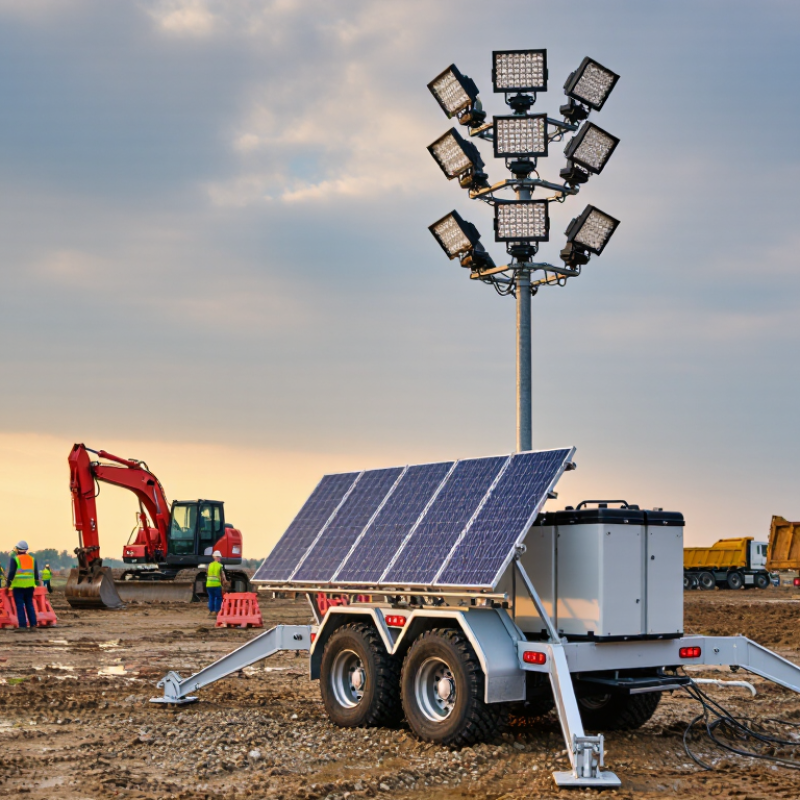
A solar light tower is a mobile lighting system powered mainly by sunlight. It combines photovoltaic panels, a rechargeable battery, an LED lighting head, and a telescopic mast. During daylight, the panels convert sunlight into electrical energy. A charge controller regulates this energy before it reaches the battery. At night, stored power runs the LED lamps.

The process sounds simple. It is modular. A timer, motion sensor, or light sensor can control operation automatically. When darkness arrives, the controller activates the lamps and protects the battery from excessive discharge. In practical field use, panel angle, dust, cloud cover, and winter daylight can change performance noticeably. That detail matters. A tower rated for ten hours may provide less runtime in shaded or cold conditions. Buyers should check battery capacity, panel wattage, mast height, lamp output, charging time, and weather resistance together. Looking at brightness alone is a common mistake. I have seen specifications appear impressive while the battery was too small for long nights. Another weakness is poor wind stability, especially on uneven ground. A wider base, reliable brakes, and clear maintenance access improve safety and daily usability. Performance claims also deserve independent testing, because ideal laboratory conditions rarely match construction sites, roads, or emergency work areas.

Key Features of the Best Solar Light Towers in 2026

2026 Best Solar Light Tower for Global Buyers

Key Features of the Best Solar Light Towers in 2026

Solar light towers are becoming practical assets for construction sites, emergency works, mining areas, and remote events. IRENA’s Renewable Capacity Statistics 2024 recorded 345.5 GW of new solar capacity added worldwide in 2023. This growth supports wider access to solar components, but quality still varies sharply.

The best 2026 models should use high-efficiency LED modules, intelligent dimming, and lithium battery storage. LED output must remain stable after several cloudy days. A larger solar panel is not automatically better. Panel angle, dust, temperature, and shading can reduce real performance. Buyers should request measured runtime, charging time, battery cycle data, and illumination tests.

Weather protection matters. IEC 60529-based ingress ratings help buyers compare resistance to dust and water. A strong tower should also include a corrosion-resistant frame, locking wheels, emergency shutoff, and a mast designed for local wind conditions. Remote monitoring is useful, but it can fail without reliable network coverage. Keep manual controls.

IRENA reported that renewables represented more than 85% of global power capacity additions in 2023. This indicates strong market momentum, not guaranteed product reliability. Procurement teams should inspect battery compartments, cable protection, spare-part access, and maintenance records. Some specifications look impressive on paper. Field conditions may disagree.

2026 Best Solar Light Tower for Global Buyers

Key Features of the Best Solar Light Towers in 2026

The chart presents practical procurement benchmarks for solar light towers in 2026. High-efficiency LED lighting, long battery autonomy, short charging time, durable outdoor protection, and sufficient mast height are key factors for reliable operation across different global markets. Actual performance depends on local solar conditions, temperature, installation angle, and operating requirements.

How to Compare Solar Light Tower Performance and Reliability

2026 Best Solar Light Tower for Global Buyers

How to Compare Solar Light Tower Performance and Reliability

Comparing a solar light tower requires more than reading its advertised lumen figure. Measure illumination at the work area, not beside the mast. A reliable unit should deliver even light across roads, yards, or emergency sites. Ask for test data showing lux levels, runtime, and charging performance under weak sunlight. Short demonstrations can hide poor overnight endurance.

Battery capacity matters, but battery management matters more. Check the battery chemistry, operating temperature range, charging protections, and replacement process. During field evaluations, record brightness every two hours after sunset. Note wind speed, cloud cover, and load settings. These details reveal performance differences that brochures often miss. Real sites are rarely perfect.

Mechanical reliability deserves equal attention. Inspect mast locks, wheel brakes, cable protection, and panel hinges before purchase. Look for corrosion-resistant materials and a clear ingress protection rating. Confirm whether the tower remains stable on uneven ground. Service manuals, spare-part access, and documented safety testing indicate stronger supplier discipline. Certification alone is not proof of durability. I would also request a live trial, because small controls can become frustrating at night. A careful comparison may expose disappointing results, and that is useful.

Global Buyer Guide to Solar Light Tower Applications

2026 Best Solar Light Tower for Global Buyers

Solar light towers now support construction sites, road repairs, emergency work, mining areas, farms, and outdoor events. The market context is strong. IRENA’s Renewable Capacity Statistics 2024 recorded about 1,419 GW of global solar capacity by the end of 2023. IEA PVPS Trends 2024 reported more than 1.6 TW of cumulative photovoltaic capacity worldwide. These figures show expanding solar experience, but they do not guarantee a suitable tower for every climate.

Application should guide procurement. A road crew may need wide, low-glare lighting across uneven asphalt. A remote clinic may value quiet operation, battery endurance, and simple maintenance. Construction teams should check measured lux levels, adjustable floodlight angles, mast height, and charging performance during cloudy days. For tropical or coastal use, review corrosion protection and enclosure ratings. For desert sites, inspect dust resistance and panel cleaning access. Small details matter.

From field experience, stated runtime can be optimistic. Battery age, winter temperatures, shade, and repeated mast movement reduce performance. Buyers should request test conditions, not only headline specifications. A practical checklist includes wind stability, emergency manual controls, transport dimensions, spare-part access, and local technical support. International shipments also need clear documentation and electrical compliance records. There is no universal winner. A compact tower may suit events but fail on a long construction shift. That mismatch is easy to overlook.

2026 Best Solar Light Tower for Global Buyers - Global Buyer Guide to Solar Light Tower Applications
Application Recommended Lighting Output Typical Mast Height Recommended Operating Time Typical Solar Module Range Typical Battery Storage Preferred Battery Type Recommended Protection Level Key Buyer Requirements
Road and Highway Construction 20,000–40,000 lm 6–9 m 8–12 hours per night 1.2–2.4 kWp 8–20 kWh LiFePO₄ for frequent cycling and lower maintenance IP65 or higher; impact-resistant enclosure Wide-area illumination, glare control, high wind resistance, towable chassis, and red-and-white safety markings
Construction Sites 15,000–35,000 lm 5–8 m 6–12 hours per night 1.0–2.0 kWp 6–16 kWh LiFePO₄ or other industrial lithium battery systems IP65 minimum; IP66 preferred for exposed sites Compact transport dimensions, emergency shutdown, anti-theft provisions, adjustable floodlight angles, and low-noise operation
Mining and Remote Industrial Areas 30,000–60,000 lm 7–10 m 10–14 hours per night 2.0–4.0 kWp 16–40 kWh Industrial LiFePO₄ with an integrated battery-management system IP66 or higher; corrosion-resistant structure Dust protection, high-temperature performance, robust frame, remote monitoring, and compatibility with site safety procedures
Ports, Yards, and Logistics Areas 20,000–50,000 lm 6–10 m 8–14 hours per night 1.5–3.5 kWp 12–30 kWh LiFePO₄ for stable long-term cycling IP66 preferred; marine-grade corrosion protection Salt-spray resistance, high-visibility lighting, low-glare optics, obstacle visibility, and optional remote status monitoring
Emergency Response and Disaster Relief 10,000–30,000 lm 4–7 m 8–12 hours per night 0.8–2.0 kWp 5–16 kWh LiFePO₄ for safety, cycle life, and transport convenience IP65 or higher Fast deployment, manual override, low transport weight, foldable or telescopic mast, visible battery status, and emergency charging access
Outdoor Events and Temporary Venues 8,000–25,000 lm 4–6 m 6–10 hours per night 0.6–1.5 kWp 4–12 kWh LiFePO₄ or sealed deep-cycle battery systems IP54 minimum; IP65 recommended for weather exposure Low acoustic noise, low glare, dimming capability, compact footprint, stable outriggers, and safe public-area cable management
Agricultural and Rural Operations 8,000–20,000 lm 4–7 m 6–10 hours per night 0.6–1.5 kWp 4–12 kWh LiFePO₄ for seasonal and repeated outdoor use IP65 recommended; UV-resistant components Simple controls, mud-resistant chassis, low operating cost, adjustable light distribution, and protection against insects and moisture
Security, Perimeter, and Temporary Facilities 5,000–15,000 lm 3–6 m 10–14 hours per night 0.5–1.2 kWp 3–10 kWh LiFePO₄ or other protected deep-cycle storage IP65 minimum Motion sensors, programmable dimming, uniform perimeter coverage, tamper resistance, and optional CCTV or alarm-system integration
Urban Maintenance and Public Works 10,000–25,000 lm 4–7 m 6–12 hours per night 0.8–1.8 kWp 5–15 kWh LiFePO₄ for low routine maintenance IP65 or higher Low-glare beam control, road-safe positioning, compact towing dimensions, weather resistance, and compliance with local work-zone requirements
Technical planning note: The ranges above are typical specification bands for commercial mobile solar light towers, not guarantees for every model. Actual performance depends on LED efficacy, lighting distribution, daily solar irradiation, temperature, shading, battery reserve settings, operating schedule, and local regulations. For global procurement, buyers should verify applicable electrical, transport, electromagnetic-compatibility, battery-transport, and site-safety requirements in the destination market.

Installation, Maintenance, Safety, and Cost Considerations

A solar light tower needs a site survey before delivery. Check winter sunlight, soil stability, drainage, and vehicle access. Keep panels away from trees, cranes, and temporary shadows. Correct mast anchoring matters during strong winds. IEA PVPS reported about 407 GW of new solar capacity worldwide in 2023. That growth supports better components, but it does not remove local installation risks. Follow the tower’s rated wind speed, lifting points, and electrical instructions.

Maintenance is simple, but not maintenance-free. Inspect panels, cables, fasteners, brakes, and battery enclosures every month. Clean dusty panels more often near construction sites. Record battery voltage and nighttime runtime. Poor charging can indicate shading, damaged wiring, or battery ageing.

Safety checks should include stable outriggers, guarded moving parts, emergency lighting controls, and clear lockout procedures. A short inspection can prevent a long shutdown. Requirements still vary by country and worksite.

Tips: Compare total ownership cost, not only the purchase price. Include transport, anchoring, replacement batteries, cleaning, inspections, and downtime. IRENA’s Renewable Power Generation Costs report shows solar PV costs fell sharply over the last decade, yet small mobile systems can remain expensive per lighted area. My practical concern is often overlooked: a tower may perform well in summer but disappoint in cloudy winter weather. Request measured runtime data, battery capacity, warranty conditions, and a site-specific lighting plan before ordering.