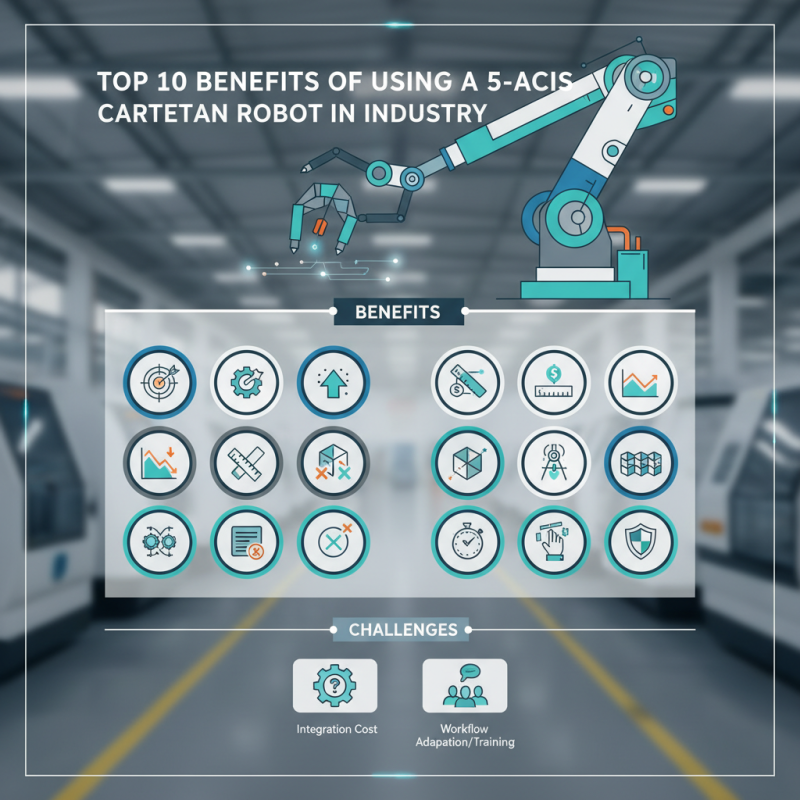
In the evolving landscape of industrial automation, the "5-Axis Cartesian Robot" stands out as a game-changer. Experts like Dr. Alex Chen, a leading authority in robotics, emphasize its impact: "The precision of a 5-Axis Cartesian Robot redefines efficiency in manufacturing." Industries worldwide are adopting these robots to enhance productivity and reduce costs.
The capabilities of a 5-Axis Cartesian Robot allow it to move fluidly in multiple directions. This flexibility leads to improved accuracy in tasks like assembly and machining. A few companies report reduced error rates, illustrating the robot's reliability. However, implementation isn’t without challenges. Teams must adapt their workflows and train employees effectively.
As industries embrace this technology, they must weigh benefits against potential drawbacks. The cost of integration and necessary infrastructure changes can be significant. While many celebrate the advantages, some experts urge caution. They highlight the importance of careful planning and assessment. Understanding these factors can help companies maximize the effectiveness of a 5-Axis Cartesian Robot.
5-Axis Cartesian robots are redefining precision in manufacturing processes. According to a 2021 report by the International Federation of Robotics, these systems can achieve tolerances as low as ±0.01 mm. This level of accuracy is crucial for industries like aerospace and medical devices, where the smallest miscalculation can lead to product failure. Enhanced precision reduces material waste, leading to cost savings.
Implementing 5-axis systems allows for complex geometry to be machined in a single setup. Traditional methods often require multiple setups, increasing the chance for error. A study by Smith & Associates shows that using 5-axis robots can increase overall efficiency by up to 30%. This efficiency boost results from reduced labor time and lower scrap rates.
However, achieving this level of precision isn't without challenges. Calibration and maintenance of such advanced systems are critical. Mistakes in setup can lead to defects, potentially consuming valuable production time. Regular training for operators is essential to mitigate these issues. The investment is significant, and companies must weigh the benefits against potential risks carefully.

In modern manufacturing, 5-axis Cartesian robots offer remarkable flexibility for complex geometries. The ability to simultaneously move along five axes allows for intricate designs that traditional robots struggle to achieve. This flexibility can streamline workflows, enabling the creation of unique shapes with precision. Industries such as aerospace and automotive are increasingly reliant on this adaptability. Their components often require complex curvatures and angles—5-axis robots excel at this requirement.
Consider a scenario where a custom part is needed for a specific application. A 5-axis robot can seamlessly handle the meticulous angles and curves needed for such parts. Its design helps reduce the need for multiple setups, thus minimizing time and potential errors. However, it's important to recognize that mastering these systems requires specialized training. Operators must understand both the machine's capabilities and its limitations.
Complex tasks often expose weaknesses in programming or operational workflows. While 5-axis robots provide advanced features, they can also lead to challenges in integration with existing systems. It's crucial for companies to assess their readiness for such technology. Investing in additional training or infrastructure may be necessary. Striking the right balance between automation and human oversight is essential for optimal outcomes.
The use of 5-axis Cartesian robots in industry has significantly transformed manufacturing processes. One key advantage is the reduction in cycle times. According to a report by the International Federation of Robotics, automation can cut production times by up to 30%. This efficiency enables companies to meet increasing demand while maintaining quality standards.
Moreover, automating repetitive tasks leads to noticeable reductions in production costs. A study by McKinsey stated that companies leveraging robotics can decrease operational expenses by around 20%. By reallocating human labor to more skilled tasks, businesses can enhance overall productivity. This shift is crucial as industries strive to remain competitive in a fast-paced market.
However, not every company has successfully navigated this transition. In some cases, the upfront investment can be daunting. Additionally, integrating new technologies into existing processes may lead to temporary inefficiencies. Companies need to carefully analyze their specific needs before adopting automation. Developing a tailored strategy can mitigate potential risks and maximize the benefits of 5-axis Cartesian robots.
In industrial environments, safety is a top priority. The 5-axis Cartesian robot enhances this aspect significantly. With its advanced precision and flexibility, workers face fewer hazards. The robot can handle repetitive tasks that often lead to injuries. This reduces strain on human workers. Ergonomic risks decrease as operators engage in less manual labor.
Additionally, the design of a 5-axis robot allows for varied movement. It can reach difficult angles and heights. This capability minimizes awkward postures that are often harmful to human workers. Workers can focus on oversight and quality control instead of physically demanding tasks. However, while these systems are beneficial, they require careful integration into current workflows. Training is essential to ensure smooth operations. Overdependence on automation may also lead to a loss of skilled jobs, which is a concern. Always consider the balance between technology and human expertise in the workplace.
In today's industrial landscape, the integration of advanced technology in robotics has transformed operational efficiency. A 5-axis Cartesian robot excels in data collection and analysis. This robot can collect precise data during its operations, which helps in refining processes. Data-driven insights boost productivity and minimize errors.
Implementing a 5-axis system offers flexibility unmatched by traditional setups. This capacity enables the robot to adapt to different tasks without extensive reconfiguration. However, reliance on technology can sometimes lead to challenges. For instance, data overload may complicate analysis, leaving operators overwhelmed. In these moments, training and user experience are crucial. Monitoring data flow ensures that the benefits outweigh potential issues.
Moreover, successful integration requires ongoing evaluation. Companies may realize they need enhancements to their collection methods. Regular reviews are vital to adapt to evolving needs. Addressing gaps in data usage can unlock further efficiencies. The pursuit of continuous improvement drives innovation in robotics.
| Benefit | Description | Use Cases |
|---|---|---|
| Increased Precision | 5-axis robots provide precise control over movement, allowing for intricate operations. | Aerospace component manufacturing, medical device assembly. |
| Reduced Cycle Time | Optimized movements reduce the time taken for task completion. | Automotive manufacturing, electronics assembly. |
| Enhanced Flexibility | Can perform a variety of tasks without reconfiguration. | Material handling, robotic welding. |
| Improved Safety | Minimizes human intervention in hazardous environments. | Heavy lifting, dangerous substance handling. |
| Cost Efficiency | Reduces labor costs and waste, increasing profitability. | High-volume production lines. |
| Versatile Applications | Suitable for numerous industries and applications. | Food processing, pharmaceuticals, automotive. |
| Data Collection Capabilities | Incorporates sensors for real-time data analysis. | Predictive maintenance, quality control. |
| Simplified Integration | Easily integrates with existing systems and CAD software. | Warehouse automation, design fabrication. |
| Scalability | Can be scaled to meet increasing production needs. | Expansion of production lines. |
Content © 2025 Komatsu. All Rights Reserved