Choosing a Fiber Opening And Pillow Filling Machine is not simply a matter of comparing prices or advertised output. The right line must open fiber without damaging it, deliver a steady feed, and fill pillows consistently. Small differences matter: tangled tufts, uneven filling, or frequent blockages can slow a shift and increase waste. Sometimes the brochure looks convincing. The production floor tells another story.
Industry figures show why careful planning matters. Textile Exchange’s Materials Market Report 2024 estimates that global fiber production reached 124 million tonnes in 2023, up from 116 million tonnes in 2022. It projects production could reach 160 million tonnes by 2030. These figures describe fiber production overall, not pillow-filling demand. Still, they highlight the scale and variety of materials manufacturers may need to process. A machine suited to one fiber blend may perform poorly with another.
This guide explains how to assess fiber compatibility, opening performance, filling accuracy, rated capacity, and dust-control features. It also considers changeover time, operator access, maintenance needs, and the space required around the equipment. Ask suppliers for test results using your actual fiber, not just a demonstration material. Check whether quoted capacity reflects your target pillow size and filling weight. One detail is easy to miss: a fast opener cannot compensate for an inconsistent feeding system. Compare the complete process, then verify the claims before investing.
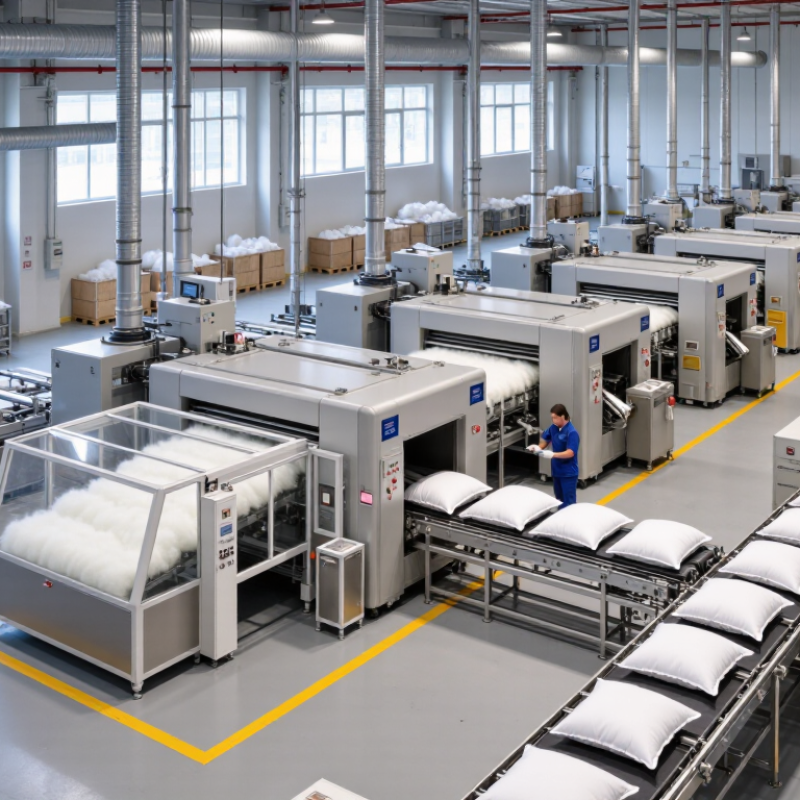
A fiber opening and pillow filling line transforms compacted fiber into a loose, usable filling. The opening machine feeds material through rollers or pinned surfaces that separate clumps and restore loft. The exact mechanism depends on the fiber and machine design. Airflow often moves the opened fiber toward a storage chamber or filling station. There, a metering system controls how much enters each pillow. An operator positions the pillow shell over a filling nozzle and adjusts the feed. That matters. Poorly opened fiber may form dense patches, while inconsistent metering can leave pillows with uneven weight or shape.
To understand a machine’s performance, observe the fiber from inlet to nozzle. Look for clumps, excessive dust, or fiber collecting inside the duct. Ask how the machine handles your actual fiber type, since recycled fill and newly processed fiber may behave differently. Check access to rollers and filters; cleaning can affect both output and downtime. A short production trial is more useful than relying on capacity figures alone. Measure filling consistency across several pillows, not just one. Small changes in airflow or feed speed can alter the result. Not always. A technically capable machine may still need careful adjustment for your material and desired pillow firmness.

Start with the fiber, not the machine’s advertised hourly capacity. Textile Exchange’s Materials Market Report 2024 estimates global fiber production reached 124 million tonnes in 2023, with polyester accounting for 57%. That scale hides major differences. Cotton, hollow conjugated polyester, recycled staple, and blends do not open alike. Record fiber length, fineness, crimp, moisture, and contamination before comparing equipment.
USDA Agricultural Marketing Service cotton classification data include staple length, micronaire, strength, and uniformity—useful inputs when cotton is part of the fill. For synthetic fibers, request supplier specifications and test a representative lot. Short, brittle fibers may need gentler opening; resilient hollow fibers can require different settings. Not identical. Do not assume one recipe fits every fiber.
Translate demand into pillow fill weight, pillows per hour, shifts per day, and changeover frequency. Multiply target units by fill weight, then allow for stoppages and rejected fill. Verify output in a timed production trial. Inspect opened fiber for clumps, dust, and uneven loft, then check finished pillows by weight and hand feel. A showroom sample can mislead. Keep trial notes, even when results seem obvious; operators may disagree about softness. Choose a line that handles your actual fiber mix at stable output, not just the cleanest sample.
How to Choose a Fiber Opening and Pillow Filling Machine?
Compare Machine Configurations and Feeding Methods
Start by matching the machine layout to your production volume and available floor space. A separate opener and filling station gives operators more control over each step. An integrated line can reduce handling between stages, but it may need more space and careful setup. Check that the opening unit suits your fiber type and breaks apart clumps without excessive damage.
Feeding methods affect consistency and labor. With manual loading, an operator places measured fiber into the hopper. This can work for smaller batches or frequent material changes, but output may vary between shifts. A conveyor or automatic feeder supplies fiber more steadily and can reduce lifting. It also needs enough buffer space and regular checks for bridging or uneven flow. Automatic feeding is not always better.
Compare the rated output with your actual pillow size and target fill weight. Ask how the machine handles low-density fiber, and whether settings can be adjusted without lengthy stops. If possible, test your own material. A sample run can reveal tangles, dust, or uneven filling that a specification sheet may not show. A small manual step can sometimes make product changes easier, though it may slow the line. Check access to cleaning points and routine maintenance areas before choosing a configuration.
Choosing a fiber opening and pillow filling machine starts with realistic production figures. Estimate the number of pillows per shift, their target fill weights, and the fiber types you process. Compare these needs with the machine’s usable hourly capacity, not just its maximum rating. A line that runs near its limit may leave little room for cleaning or material changes. Measure twice.
Controls affect both consistency and operator workload. Look for adjustable feed rates and clear settings for opening and filling. Run a sample batch, then weigh several pillows to check whether fill levels stay consistent. Simple controls can reduce training time, but operators still need access to clear stop buttons and safe maintenance procedures. A paper estimate can look reassuring. It is not the whole story.
Check facility compatibility before ordering. Measure doorways, ceiling clearance, and the space needed to load fiber and remove finished pillows. Confirm that electrical service, ventilation, and dust collection meet the machine’s stated requirements. Leave room to reach filters, belts, and other routine service points; a tight layout can turn small maintenance tasks into delays. Noise and floor vibration matter too, especially near packing or inspection areas. If possible, test the machine with your own fiber. Results from a different material may not predict how yours feeds or fills.
Safety, maintenance, and supplier support affect daily production, not just purchase price. Check that guards cover belts, rollers, and other moving parts, and test emergency stops and access-door interlocks during acceptance. Ask how the machine isolates electrical and pneumatic energy before cleaning or clearing a jam. OSHA estimates that effective lockout/tagout practices prevent about 120 deaths and 50,000 injuries each year. The figures cover many industries, but the hazard is familiar on fiber-processing lines. Small checks matter.
Maintenance needs to fit the material and the shift. Ask to inspect filter access, lubrication points, wear parts, and areas where loose fibers collect. A blocked filter or difficult-to-reach bearing can turn a short service task into lost production. The U.S. Department of Energy’s 2010 Operations & Maintenance Best Practices Guide reports that predictive maintenance can reduce maintenance costs by 8–12% compared with preventive maintenance. That is a useful benchmark, not a guaranteed saving for every machine. A perfect checklist cannot predict every jam.
Supplier support should be specific and verifiable. Request a recommended spare-parts list, typical lead times, service response targets, and clear manuals in a language your operators understand. Confirm whether training covers safe shutdown, routine cleaning, and fault diagnosis—not just startup. Ask for references from facilities with similar fiber types and output needs. If answers stay vague, pause. A low purchase price may be less attractive when a small sensor or filter keeps the line idle.
Content © 2025 Komatsu. All Rights Reserved