How to Choose the Best PP Geogrid for Your Project
Choosing the right Pp Geogrid can determine whether a reinforced soil structure remains stable after years of traffic and weather. The decision should begin with the project’s actual demands, not a product brochure. Consider subgrade strength, fill quality, load frequency, slope angle, drainage, and expected service life. A grid that performs well beneath a warehouse may be unsuitable for a soft rural access road.
In practice, engineers compare aperture size, tensile strength, junction efficiency, stiffness, and resistance to installation damage. Soil interaction matters just as much. A strong product may still underperform if its openings do not engage properly with the selected aggregate. Review manufacturer test reports, quality certifications, design calculations, and installation guidance. Independent laboratory data can also reveal differences hidden behind similar strength ratings. Small details matter, including overlap length, anchoring, wrinkles, and aggregate placement height.
Field experience teaches a less comfortable lesson: early assumptions are often incomplete. Site moisture can change overnight. Unexpected soft pockets may appear beneath seemingly firm ground. No product is universally best. The most reliable choice balances engineering evidence, construction practicality, budget, and long-term risk. Speak with qualified geotechnical professionals when conditions are complex or consequences are significant. A careful selection process protects more than the pavement surface. It supports safer construction, fewer repairs, and performance that can be defended with clear technical reasoning. Yet even a well-designed solution deserves inspection after installation. Conditions change. Good judgment keeps learning.
Define PP Geogrid and Its Role in Soil Stabilization
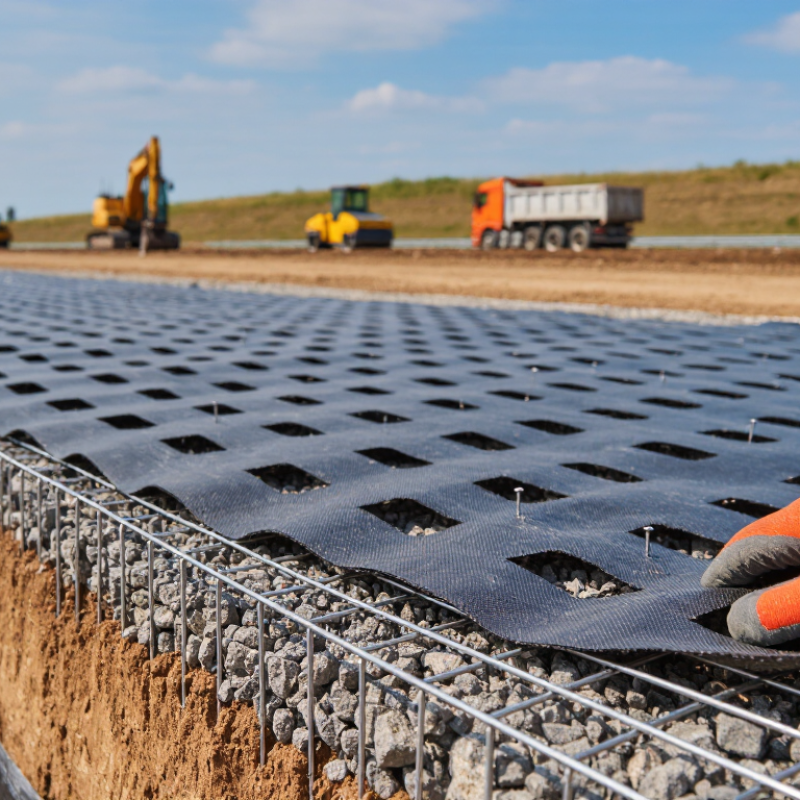
Polypropylene (PP) geogrid is a polymer grid manufactured by punching and stretching PP sheets. Its open apertures allow aggregate particles to lock into the grid. This interlock improves load distribution and limits lateral movement in weak soil. Biaxial geogrids support roads with multidirectional loading. Uniaxial types suit retaining structures and steep slopes.
The Federal Highway Administration’s Geosynthetic Design and Construction Guidelines (FHWA NHI-07-092) describes geogrid reinforcement through tensile capacity, junction strength, aperture stability, and soil interaction. These values matter more than product weight. ASTM D6637 and ISO 10319 test tensile performance, while site design must also consider creep, temperature, installation damage, and chemical exposure. Project reports commonly show aggregate savings of about 15% to 30% in suitable pavement sections, but this range is not guaranteed. Soil conditions decide the result.
Selection should begin with a soil investigation, not a catalog. Check the subgrade’s soaked California Bearing Ratio, drainage, construction traffic, and aggregate size. A soft, wet subgrade may require separation geotextiles, drainage, or deeper improvement. Geogrid alone cannot solve every failure. That is an easy assumption to challenge. During installation, wrinkles, sharp rock, poor overlaps, and trafficking directly over exposed grid can reduce performance. Specify tested junction strength and installation requirements, then verify compaction and overlap on site. A practical choice is rarely the strongest grid. It is the grid whose tested properties match the soil, load, climate, and construction method.
Assess Project Conditions and Reinforcement Requirements
How to Choose the Best PP Geogrid for Your Project
Assess Project Conditions and Reinforcement Requirements
Choosing a PP geogrid begins with the ground beneath the proposed structure. Review soil type, moisture, drainage, slope, traffic loading, and expected settlement. A soft clay subgrade needs different reinforcement than compacted sand. Small details matter.
Field testing should guide the decision. Useful data includes CBR values, plate load results, grain size, and groundwater depth. Walk the site after rainfall if possible. Drainage changes everything. Water can weaken the subgrade and reduce aggregate interlock, even when laboratory results appear acceptable.
Match the geogrid’s tensile strength, aperture size, junction performance, and stiffness to the project demand. For a temporary access road, rut resistance may control the selection. A heavily loaded pavement may require stronger confinement and better long-term creep resistance. Consider installation conditions too, including overlaps, turning equipment, temperature, and possible damage from sharp aggregate.
Do not choose solely from a strength number. Reinforcement performance depends on soil interaction, placement quality, and construction control. A neat calculation is not enough. On difficult sites, a trial section can reveal unexpected rutting or movement before full installation. Measure twice. Recheck the design when soil conditions change, because the original survey may miss weak pockets or seasonal groundwater. A practical specification should state testing requirements, overlap dimensions, subgrade preparation, and inspection points clearly.
Compare PP Geogrid Types, Strengths, and Aperture Designs
How to Choose the Best PP Geogrid for Your Project
PP geogrids differ mainly in structure, tensile strength, and aperture design. Uniaxial grids provide strong reinforcement in one direction. They suit steep slopes, retaining structures, and load paths with clear alignment. Biaxial grids distribute forces across two directions. They are commonly used beneath roads, parking areas, and working platforms. Triaxial designs can improve multidirectional confinement, but their performance depends heavily on soil type and installation quality.
Strength values should never be reviewed alone. Check machine direction strength, cross-machine strength, junction efficiency, and elongation at the specified strain. A grid with high peak strength may perform poorly if its junctions deform during construction. Creep resistance also matters under long-term loads. Polypropylene offers low moisture absorption, but prolonged ultraviolet exposure still requires proper covering and storage.
Aperture size controls aggregate interlock. Smaller openings can suit fine, well-graded materials, while larger openings may lock effectively with coarse crushed stone. The best match is not always obvious. Oversized apertures can allow excessive particle movement. Very small apertures may reduce mechanical engagement. Inspect the fill gradation, compaction equipment, and expected traffic before selecting the grid. Field observations often show that wrinkles, weak overlaps, or poor subgrade preparation cause more trouble than a modest strength difference. Request independent test data and installation guidance, then compare the product’s tested behavior with your actual site conditions.
Evaluate Material Quality, Durability, and Installation Needs
How to Choose the Best PP Geogrid for Your Project
Material quality should be judged by tested performance, not a bright roll or low price. Polypropylene geogrids must show tensile strength, junction efficiency, aperture stability, and creep resistance. ASTM D6637 measures tensile properties, while ISO 10319 supports wide-width tensile testing. These results should match the project’s calculated loads.
Durability also depends on soil chemistry, ultraviolet exposure, and construction damage. FHWA’s Geosynthetic Design and Construction Guidelines, FHWA NHI-07-092, stresses proper reduction factors for installation damage, creep, and durability. A geogrid that performs well in a laboratory may fail after sharp aggregate tears the ribs. That detail is easy to underestimate. Review long-term test data, not only peak strength. Check whether the report uses actual project temperatures and loading conditions.
Tips: Request independent test reports and installation instructions. Confirm the roll width, overlap, anchorage, and cutting method before delivery. During placement, keep the grid flat and remove wrinkles. Walk the site before covering it. One overlooked tear can weaken a larger reinforced area. I would also allow time for a trial section. It may expose poor soil preparation or an unsuitable aperture size early. That extra step can feel unnecessary, but skipping it is often the costlier choice.
How to Choose the Best PP Geogrid for Your Project
Recommended minimum tensile-strength ranges vary by application. Select a PP geogrid by checking design loads, junction performance, resistance to installation damage, UV exposure, and compatibility with the aggregate and subgrade.
The values show common preliminary screening ranges in kN/m for project planning: approximately 20 kN/m for light subgrade stabilization, 40 kN/m for general road-base reinforcement, 60 kN/m for heavy-duty pavements, and 80 kN/m for high-load platforms. Final selection should be confirmed by a qualified design engineer using site-specific calculations and verified product test data.
Select the Most Suitable PP Geogrid for Your Application
Selecting the most suitable PP geogrid starts with the soil, not the product label. A roadway over soft clay needs different reinforcement from a retaining wall over compacted gravel. I have seen projects fail when engineers selected tensile strength alone. Subgrade moisture, aggregate size, traffic loading, and drainage also matter. Fine soil may require a smaller aperture for better particle interaction. Coarse stone may need a larger aperture for effective interlock.
Match the geogrid structure to the load direction. Biaxial PP geogrids distribute loads across roads and working platforms. Uniaxial types usually support walls, slopes, and other applications with one dominant force. Review tensile strength, junction efficiency, creep resistance, and aperture stability. Do not ignore installation damage. Sharp aggregate can puncture or distort poorly protected material. Ask for independent test reports and confirm values under realistic temperatures.
Field conditions often change the original design. My early mistake was trusting laboratory results without checking the actual fill. A small trial section can reveal wrinkles, weak overlaps, or poor compaction. Measure the prepared subgrade, inspect drainage paths, and record overlap lengths before covering the grid. Follow the relevant engineering standards and obtain advice from a qualified geotechnical professional. Higher strength is not automatically better. The right PP geogrid works with the soil, construction method, and expected service life.
How to Choose the Best PP Geogrid for Your Project - Select the Most Suitable PP Geogrid for Your Application
| PP Geogrid Type | Typical Tensile Strength | Typical Aperture | Primary Load Direction | Recommended Applications | Key Selection Benefit |
| Biaxial, light-duty | 20–40 kN/m in both principal directions | Approximately 20–40 mm | Two directions | Residential driveways, pedestrian areas, lightly trafficked access roads, and separation over stable subgrades | Cost-effective confinement of aggregate layers where traffic and subgrade demands are moderate |
| Biaxial, medium-duty | 40–80 kN/m in both principal directions | Approximately 25–50 mm | Two directions | Paved and unpaved roads, parking areas, industrial yards, and working platforms | Improves aggregate interlock and helps distribute repeated traffic loads |
| Biaxial, heavy-duty | 80–120 kN/m or higher in both principal directions | Approximately 30–65 mm | Two directions | Heavy-haul roads, container yards, logistics areas, airport pavements, and weak-to-moderate subgrades | Provides higher in-plane stiffness and better resistance to rutting under substantial traffic |
| Uniaxial, longitudinal | 60–200 kN/m or higher in the machine direction | Approximately 15–40 mm | One primary direction | Mechanically stabilized earth walls, reinforced slopes, embankments, and steep-grade soil reinforcement | Develops high tensile resistance along the direction of expected soil movement |
| Uniaxial, transverse | 20–80 kN/m in the transverse direction | Approximately 20–50 mm | One primary direction | Applications where lateral stability or cross-slope reinforcement governs the design | Allows reinforcement to be oriented to resist the project’s dominant lateral forces |
| High-junction-efficiency geogrid | Select according to the required design strength; junction performance is critical | Project-specific, commonly 25–65 mm | One or two directions | High-traffic pavement systems, reinforced soil structures, and projects requiring reliable load transfer | Strong junctions help maintain aperture stability and transfer forces between ribs |
Selection checklist: Choose the geogrid according to the design tensile strength, tensile strength at the required strain, junction efficiency, aperture size, installation conditions, aggregate grading, subgrade strength, chemical exposure, temperature, and required service life. The ranges shown are typical selection categories rather than product specifications; final selection should be verified against project calculations and the manufacturer’s certified test data.