How to Choose the Right Carbon Fiber Sheets in 2026?
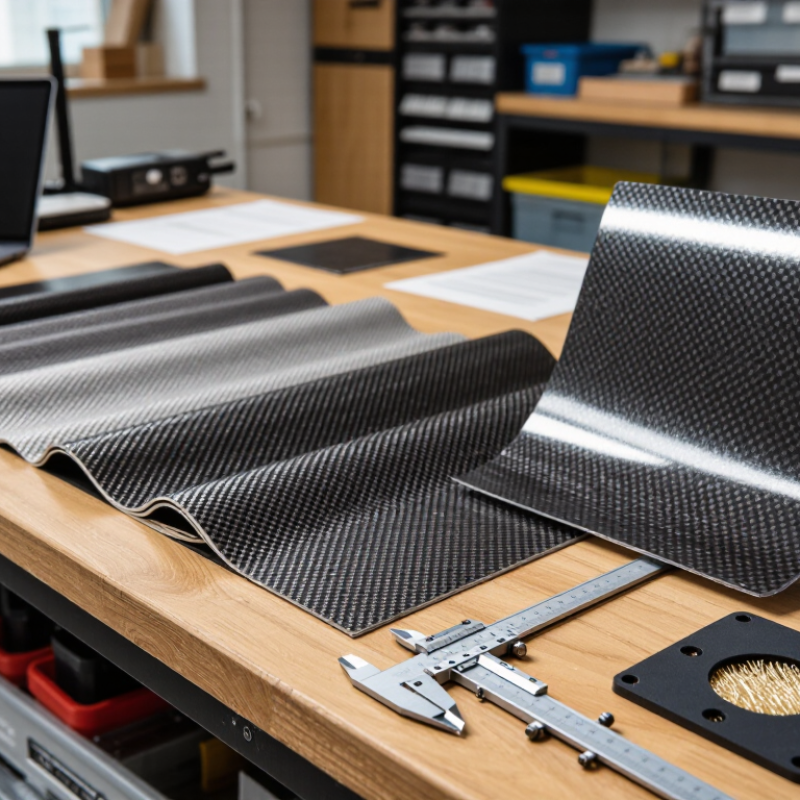
Choosing carbon fiber sheets in 2026 is less about finding the “strongest” panel and more about matching its construction to the job. A decorative sheet for a dashboard has different demands from a structural laminate for a bracket or equipment enclosure. Look closely. Weave pattern, thickness, fiber orientation, resin system, and surface finish can affect stiffness, weight, appearance, and machining behavior. A glossy twill may catch the workshop lights, but its appearance alone cannot confirm that it is suitable for a load-bearing part.
Start with the intended use, then compare manufacturer data for thickness tolerance, laminate construction, and mechanical properties. Check whether the figures describe the same direction and test conditions; carbon fiber is anisotropic, so strength can vary with fiber orientation. Small details matter. A cut edge, mounting hole, or tight bend may expose weaknesses that a flat sample does not reveal. For demanding applications, seek traceable technical documentation and have a qualified engineer assess the design rather than relying on a product description.
Cost also deserves a closer look. A lower-priced sheet may need extra finishing, while a premium surface may add little value to a hidden component. Ask about dimensions, cutting tolerances, storage, and resin compatibility before ordering. If possible, inspect a sample under the lighting and conditions where it will be used. That step is easy to skip. I would not assume every supplier’s “high strength” label means the same thing; clear specifications are more useful than broad claims. This guide outlines practical checks for choosing a sheet that fits your performance needs, budget, and fabrication process.
Understanding Carbon Fiber Sheets and Their Key Properties
Carbon fiber sheets combine strong carbon filaments with a resin matrix, but their properties depend on how those layers are arranged. Woven sheets often resist loads in two main directions, while unidirectional laminates favor one direction. The visible weave can be attractive. Looks matter. Not enough. A glossy surface does not reveal the sheet’s strength, stiffness, or internal consistency. Check the technical data, including thickness, fiber orientation, and the direction in which performance was measured.
For a practical choice, start with the load the sheet must carry and the space available. A thin panel may save weight, yet flex more than expected; adding thickness can affect fit and cost. Small detail. Compare the stated properties with your actual use, not just a headline strength figure. Moisture, heat, impact, and repeated vibration may also influence performance. If the sheet will be cut, consider edge quality and use suitable dust controls, since cutting composite material creates fine particles. Some product data can be hard to compare because test methods differ. That uncertainty deserves attention, especially when a part must fit closely or carry a critical load.
Comparing Fiber Layouts, Thicknesses, and Resin Systems
Choosing carbon fiber sheets starts with fiber layout, not appearance. Unidirectional sheets carry loads efficiently along one axis, while plain-weave cloth handles loads from multiple directions and resists fraying during cutting. For a bracket pulled in one direction, align the fibers with the load. For a panel with changing forces, a balanced layup is usually safer. There is a trade-off: extra layers add weight and may not improve the part where it matters.
Thickness should match the span, support points, and expected impact. A thin sheet can flex noticeably between widely spaced fasteners; a thicker one may crack around a tight hole if poorly supported. Measure the actual part, then test a small coupon. That step is easy to skip. It is also where a weak resin bond or rough cut edge often shows up.
Resin choice affects heat tolerance, toughness, and processing. Epoxy is common for structural sheets, while other resin systems may suit different production needs. Check the temperature rating and confirm the resin is compatible with coatings or adhesives. GWEC’s Global Wind Report 2024 recorded 117 GW of new wind capacity in 2023, underscoring demand for durable composite structures. That figure is not a sheet-selection rule, though. NASA’s Composite Materials Handbook-17 also stresses that laminate performance depends on the full construction, not fiber strength alone. For uncertain loads, compare supplier test data with the finished part’s real support and use conditions.
How to Choose Carbon Fiber Sheets in 2026?
Estimated areal mass by sheet thickness, using a representative cured-laminate density of 1.55 g/cm³.
Areal mass is calculated as density × thickness; actual sheets vary with fiber volume, resin content, and manufacturing. Unidirectional layouts prioritize stiffness along the fiber direction, while woven layouts provide reinforcement in multiple directions. Epoxy is commonly selected for structural laminates; choose the resin and layup for the service temperature, environment, loading direction, and intended use.
Checking Quality Standards, Manufacturing, and Durability
Choosing carbon fiber sheets in 2026 starts with the job they must do. A glossy face is not proof of strength. Check the datasheet for thickness tolerance, fiber orientation, resin type, and test results. Ask whether reported values apply to the finished panel or just the raw fiber. They are not interchangeable. Look for batch-linked reports and named test methods, such as tensile or flexural testing under a recognized standard. Standards and revisions can differ, so compare like with like.
Manufacturing details shape performance. Prepreg panels and wet-laid panels may have different consistency, and neither process alone guarantees quality. Ask how the sheet is cured and inspected. Uneven weave, resin-rich patches, pinholes, or rough edges can signal problems worth investigating. Small flaws matter. Durability depends on the environment: heat, moisture, sunlight, chemicals, and repeated loading can affect the resin and laminate. Choose a panel tested for conditions close to yours, and check its care limits. I once focused too much on stiffness and too little on edge damage; that was a useful, slightly expensive lesson. For critical parts, have a qualified engineer confirm the design and safety margins.
Evaluating Suppliers, Costs, and Purchase Requirements
Choosing a carbon-fiber sheet starts with the job it must do. Record the required thickness, dimensions, weave, resin system, and fiber direction. A panel for a light enclosure may not need the same stiffness or finish as a structural part. Grand View Research estimated the global carbon-fiber market at USD 5.48 billion in 2023 and projected an 11.9% compound annual growth rate from 2024 to 2030. That market forecast signals demand, not a guaranteed price for sheets. Small details matter.
Compare suppliers using the same written specification. Ask for material data sheets, batch traceability, thickness tolerances, and test results relevant to your application. Ask for evidence. If flatness or cosmetic finish matters, request sample panels and inspect the edges, surface, and cut quality under consistent lighting. A neat sample is useful, but it cannot replace documented production controls.
Request itemized quotes covering sheet price, minimum order quantity, cutting, packaging, shipping, and expected scrap. A low unit price can become expensive when the sheet size creates substantial offcuts. Confirm lead time and how substitutions are handled before ordering. For critical parts, consider independent testing against suitable methods, such as ASTM D3039 for tensile properties. I would not assume that two sheets with identical thickness perform alike; resin content and layup can change the result. That assumption is easy to miss.