
How Does an Automatic Water Spray Retort Use Steam?
In an automatic water spray retort, steam supplies heat while circulating water carries it across packages. Depending on the retort design, steam may heat the vessel directly or transfer heat to the water through a heat exchanger. Pumps then send heated water through spray nozzles, creating a moving curtain over cans, jars, or pouches. The practical goal is steady heat distribution—not simply a high steam pressure reading.
This distinction matters. The FDA’s Guide to Inspections of Low-Acid Canned Food Manufacturers explains why scheduled thermal processes and heat-penetration records matter for commercial processing. FDA regulation 21 CFR Part 113 also sets requirements for low-acid canned foods; it does not prescribe one universal steam setting for every retort. The U.S. Department of Energy’s Improving Steam System Performance: A Sourcebook for Industry offers useful guidance on steam generation, distribution, and condensate management. These sources point to a key operating reality: steam demand depends on the load, package format, starting temperature, and equipment configuration.
For operators, Automatic Water Spray Retort Steam is best understood as part of a controlled heat-transfer system. Watch the temperature record, spray pattern, and condensate return. A blocked nozzle or unevenly loaded basket can change conditions. Small details count. One limitation in many simple explanations is that they make steam use sound uniform. It is not. Verify performance through qualified process authority review and equipment-specific validation, rather than relying on a generic cycle description.
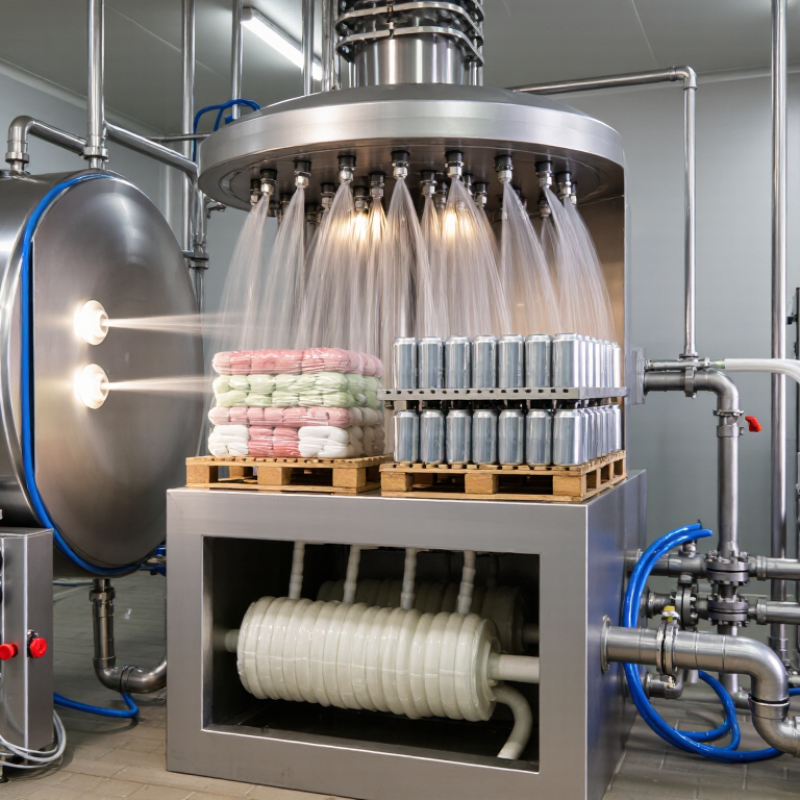
Before loading an automatic water-spray retort, check that spray nozzles, filters, drains, and basket supports are clean and unobstructed. Confirm temperature sensors and pressure instruments are within their calibration schedule. Steam may heat the circulating water directly or through a heat exchanger, depending on retort design. The spray then distributes heat across the packaged load, while controlled pressure helps protect flexible containers.
Small gaps matter. Follow the validated loading pattern, leaving the specified clearance between baskets and packages so water can reach all surfaces. Do not assume a tightly packed basket will process evenly.
Inspect packages for leaks, crushed seams, or trapped product around closures. Load them in the orientation and quantity specified by the scheduled process; avoid mixing formats unless that combination has been assessed. FDA regulations define low-acid canned food using an equilibrium pH above 4.6 and water activity above 0.85, thresholds that affect process classification (21 CFR 113.3). They also require processing records to be retained for three years (21 CFR 113.100).
Record the product, package size, load arrangement, initial temperature, and retort identification before the cycle begins. It is easy to miss. A quick visual check is useful, but it cannot replace documented process validation by a qualified process authority.

In an automatic water spray retort, steam supplies heat to the water that circulates over packaged products. Depending on the equipment design, steam may heat the water through a heat exchanger or enter the water directly. In either case, the goal is controlled heating, not simply adding steam as quickly as possible.
When the cycle begins, a pump moves water through spray nozzles while temperature sensors monitor conditions inside the vessel. Steam passes through a control valve, and its heat raises the circulating water toward the programmed temperature.
The spray forms a steady sheet across trays and containers. This helps reduce cold spots, though loading patterns and nozzle condition still matter. The details matter.
As the water warms, automatic controls adjust steam flow to limit temperature swings. Operators should check sensor readings, valve response, and spray coverage during routine maintenance. A blocked nozzle can disrupt distribution, even when the displayed temperature looks correct.
Not instantly.
Heating performance also depends on vessel size, product load, and initial water temperature. Since retort designs differ, the equipment manual should guide decisions about steam pressure and water-heating settings.
A little uncertainty is normal; unexplained variation deserves investigation.
How Does an Automatic Water Spray Retort Use Steam?
Circulating Heated Water Across the Product Packages
In an automatic water-spray retort, steam usually heats the circulating process water rather than contacting each package directly. Water is heated inside the vessel or in a steam-heated exchanger. A pump then sends it through spray headers and nozzles, washing warm water over cans, jars, or pouches. Heat passes through each package wall to the food inside. The product warms gradually. That matters.
During processing, the controls manage water temperature, circulation, and timed stages. Nozzles need to distribute water across the load, but blocked openings, tight spacing, or poor loading can create colder areas. Operators monitor sensors, pump performance, and spray patterns. The scheduled process should be validated for the specific product, package, and loading arrangement. Steam pressure alone cannot confirm that every package received the intended heat.
A steady sheet of water can look reassuring, but appearance is not a measurement. Water may flow around tightly packed containers instead of reaching every surface evenly. Small details matter. Basket position and package orientation can affect circulation. Water returns to the heating system and is reheated as needed, helping limit temperature swings. Records should capture actual cycle data, not only set points. It is worth checking whether spray coverage remains consistent after maintenance or loading changes.
Illustrative retort water-temperature profile during heating, holding, and cooling.
Steam transfers heat to circulating water, which is sprayed across product packages for even heat distribution. The profile is illustrative, not a validated production recipe.
In an automatic water spray retort, steam supplies heat while circulating water spreads it across the load. Depending on the equipment design, steam may heat the vessel directly or warm the spray water through a heat exchanger. Nozzle coverage matters: blocked or uneven sprays can create temperature differences between packages.
A programmed controller follows the selected process schedule. Sensors track vessel temperature and pressure, while valves regulate steam entry and, where applicable, cooling water. Small changes matter. The display may show a stable temperature, but readings alone do not prove every package received the required heat. Product arrangement, container size, and water flow all affect heat transfer.
Pressure control protects containers as temperatures rise and fall. The system may use compressed air or controlled steam pressure to balance pressure inside flexible packages or sealed containers. During heating, operators should watch for slow temperature recovery after loading and unusual pressure swings. During cooling, pressure must be managed as the vessel temperature drops. Even so, an automatic cycle is not a substitute for a validated process and routine checks. A slightly uneven load can be easy to overlook.
After the heating cycle, an automatic water spray retort begins cooling while carefully controlling pressure inside the vessel. Water flows through spray nozzles and reaches the containers as a fine, moving sheet. The products cool gradually, rather than meeting a sudden temperature drop. Pressure control matters. It helps protect sealed cans, jars, and pouches from bulging or damage while their contents are still hot.
Operators can watch temperature and pressure readings as cooling progresses. A steady spray pattern helps reduce uneven cooling, though perfect uniformity is difficult in a densely loaded retort. Container position and water flow can make a difference. The cooling schedule should be established and checked for the specific product, package, and load arrangement. Clean cooling water is important, too, especially when package seals or closures could be exposed to contamination. Small details count. A slow response to a pressure change may affect package integrity, so alarms and routine equipment checks deserve attention. I would not assume that a familiar load cools exactly like the last one; product size and placement can shift the results.
Content © 2025 Komatsu. All Rights Reserved