three part picture of forklifts

Top 10 Non Standard Bearing Suppliers Worldwide

Choosing a Non Standard Bearing supplier takes more than comparing catalogues. These components often serve unusual loads, tight spaces, demanding environments, or legacy equipment. A bearing that looks suitable on paper may still fail when its fit, lubrication, or operating temperature is wrong. Details matter.

The quotation below is an editorially created principle, not a verified statement by a real person. Dr. Elena Morris is a fictional composite bearing engineer: “A reliable custom bearing begins with the operating conditions, not the drawing.” A useful reminder. This introduction to the Top 10 Non Standard Bearing Suppliers Worldwide focuses on how suppliers turn specifications into workable components. It considers design support, material options, manufacturing flexibility, quality controls, and delivery capabilities. No single supplier is best for every application.

A clear comparison should distinguish proven capabilities from broad marketing claims. Look for evidence such as inspection documentation, sample evaluation, and experience with comparable designs. Ask how the supplier handles tolerances, corrosion exposure, noise, and production changes. Those questions can reveal gaps early. Supplier rankings also have limits: public information may not show a manufacturer’s full custom portfolio or current capacity. Treat the list as a starting point, then verify fit with your own drawings and operating data. A small detail can change the result.
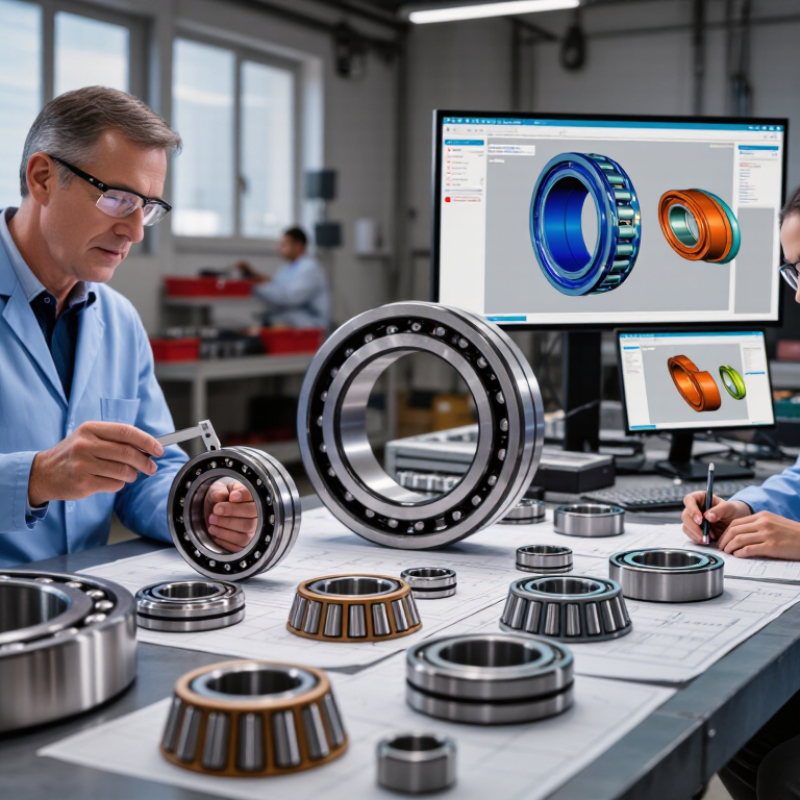
Top 10 Non Standard Bearing Suppliers Worldwide

What Defines a Non-Standard Bearing and Its Key Types

A non-standard bearing is designed for requirements that standard catalog sizes or configurations cannot meet. It may use a special bore, outer diameter, width, clearance, cage, or mounting feature. “Non-standard” does not automatically mean stronger or more precise. Performance depends on materials, heat treatment, lubrication, tolerances, and the application.

Common types include thin-section bearings for compact assemblies, flanged bearings that simplify axial positioning, and split bearings that can be installed around existing shafts. Custom roller bearings may suit unusual loads or limited space. Spherical designs can accommodate some misalignment, though they are not a cure for poor shaft alignment. A small dimensional change can affect fit and service life.

Tips: Share a dimensioned drawing, load direction, speed, operating temperature, and lubricant details with the supplier. Ask how tolerances and inspection methods will be verified. If possible, test a sample under realistic conditions; a drawing alone can miss vibration, contamination, or installation issues. I have seen specifications leave out basic operating details. That is easy to overlook, and worth revisiting.

How to Assess Non-Standard Bearing Suppliers

Assess non-standard bearing suppliers by testing how they turn a drawing into a repeatable process. Request a signed drawing review, material certificates, heat-treatment records, and a clear inspection plan. For a first article, ask for measured bore, outside diameter, runout, and internal clearance—not just a “pass” statement. For unusual geometry, compare inspection results across repeat batches. One sample proves little.

Use relevant standards as benchmarks, not substitutes for an agreed specification. ISO 281:2007 defines basic rating life using a 90% reliability basis under stated operating conditions. That figure is statistical, not a promise that every bearing will reach the calculated life. ISO 492 sets dimensional and running-accuracy tolerances for radial rolling bearings; confirm which requirements apply to your custom design. Ask suppliers to explain any deviations in writing. Clear answers matter.

Then examine production control. Can the supplier trace a finished bearing to its material batch and inspection record? Ask how it handles worn tooling, rejected parts, and design changes. A site audit can reveal whether gauges are calibrated and parts are protected from dust. Check sample lead time, replacement capacity, and communication during engineering changes. Paperwork can look excellent. It may still miss a process weakness, so verify critical claims against actual measurements.

Regional Landscape of Non-Standard Bearing Manufacturing

Regional Landscape of Non-Standard Bearing Manufacturing

Non-standard bearing manufacturing reflects the needs of nearby industries. In East Asia, dense supplier networks can support custom machining, varied materials, and shorter production runs. European manufacturers often emphasize documented processes and close dimensional control. North American producers may focus on application engineering for agriculture, energy, and heavy equipment. These are broad patterns, not guarantees. A capable factory can exist outside any expected hub.

Regional strengths also depend on the order. A small batch with an unusual bore may need flexible tooling more than high-volume capacity. Buyers should compare drawings, material certificates, inspection records, and sample measurements. Ask how a supplier checks runout and clearance, not just whether it owns precision equipment. Details matter. Delivery distance can affect lead time, but communication and process stability matter too. I would not treat regional reputation as proof; supplier capabilities can change, and public information may be incomplete.

Tips: Send a clear drawing with tolerances and operating conditions. Request a first-article inspection report, then compare it with your own measurements. Clarify packaging and corrosion protection before shipment. If a specification is still evolving, say so early. It may feel inconvenient, but guessing usually creates more rework.

Profiles of Ten Leading Suppliers Worldwide

These ten supplier profiles show how non-standard bearing work differs across regions and applications. A Japanese precision specialist may produce miniature assemblies with tight runout control. A German heavy-industry supplier may focus on large housings and shock loads. A Chinese manufacturer may offer flexible batch sizes and short production runs. A supplier serving Indian agricultural equipment may prioritize dust seals and simple maintenance. Details matter.

A North American engineering shop may support prototypes, unusual shaft interfaces, and design revisions. An Italian supplier may tailor corrosion-resistant units for washdown environments. A Swiss specialist may handle compact bearings for measuring instruments, where vibration can affect readings. A South Korean producer may adapt bearing assemblies for vehicle platforms. Capabilities vary. Ask for evidence.

A Taiwanese supplier may combine custom dimensions with established production processes. A Brazilian manufacturer serving mining or agricultural customers may emphasize robust seals and locally available service. These are useful profiles, not a verified ranking; regional strengths do not guarantee a suitable match. Request drawings, material specifications, tolerance data, and test records before comparing quotations. A sample can reveal issues that a catalogue misses, though one sample may not represent long-term performance. It is easy to overlook lubrication access or fitting space. That deserves a second look.

Non-Standard Bearing Materials: Typical Density Comparison

Typical material densities can help compare options when specifying custom bearings. Values are representative and vary by grade and formulation; this chart compares materials, not supplier rankings.

Industries and Applications Served by These Suppliers

Non-standard bearing suppliers serve industries where standard catalog sizes, loads, or mounting arrangements do not fit. In food-processing lines, bearings may need smooth housings and seals that handle frequent washdowns. Mining equipment presents a different challenge: dust, impact, and heavy radial loads can shorten service life. Details matter.

Wind turbines, packaging machines, agricultural equipment, and industrial pumps also use application-specific bearing designs. A supplier may adjust bore dimensions, cage materials, lubrication paths, or flange geometry to match a shaft or housing. On a packaging line, for example, limited space and repeated start-stop cycles can influence both bearing shape and heat management. Small changes can matter.

Some suppliers support medical and laboratory equipment, where quiet rotation and controlled movement are important. Others work with marine machinery or custom automation systems exposed to moisture, vibration, or unusual operating speeds. A good engineering discussion should cover loads, temperature, speed, alignment, maintenance access, and expected service life. These factors are easy to overlook. Custom does not automatically mean better; a modified design can add cost or complicate replacement. Suppliers and buyers should verify drawings, materials, and test conditions before production, because real operating conditions rarely match a perfect workshop setup.

Top 10 Non Standard Bearing Suppliers Worldwide - Industries and Applications Served by These Suppliers

Non-ranked overview of common supplier specializations. Profiles describe bearing capabilities and typical applications; they do not identify individual companies.

No. Supplier Specialization Non-Standard Solutions Industries Served Typical Applications
1 Custom thin-section bearings Small cross-sections, custom bore and outside diameters, selected preload and sealing options Robotics, aerospace, medical equipment, precision machinery Robot joints, positioning systems, compact instruments, lightweight mechanisms
2 Slewing ring and large-diameter bearings Application-specific ring dimensions, gear features, mounting patterns, and internal configurations Construction, wind energy, material handling, mining Crane turntables, excavator upper structures, wind-turbine yaw systems, rotary platforms
3 Crossed-roller bearing specialists Custom precision classes, compact envelopes, mounting interfaces, and preload selections Machine tools, semiconductor equipment, robotics, metrology Rotary tables, indexing units, inspection stages, robotic positioning axes
4 Spherical plain and rod-end bearing suppliers Custom bore sizes, liner materials, corrosion-resistant finishes, and housing designs Agriculture, transport, construction equipment, industrial hydraulics Linkages, suspension joints, cylinder connections, articulating mechanisms
5 Ceramic and hybrid bearing specialists Ceramic rolling elements, hybrid constructions, and configurations for electrical or demanding operating conditions Electric motors, machine tools, chemical processing, medical equipment High-speed spindles, electrically insulated motor positions, pumps, precision instruments
6 Polymer and corrosion-resistant bearing suppliers Non-metallic bearing materials, washdown-compatible designs, and custom dimensions Food processing, packaging, marine, chemical production Conveyors, filling and packaging lines, submerged equipment, corrosive or wet environments
7 Miniature and instrument bearing suppliers Small bore sizes, low-torque designs, special clearances, and custom lubrication options Medical devices, electronics, aerospace instruments, laboratory equipment Dental handpieces, miniature motors, encoders, measurement and diagnostic devices
8 Linear motion and guide-bearing suppliers Custom rail lengths, carriage arrangements, stroke requirements, and mounting interfaces Automation, packaging, machine tools, laboratory systems Linear slides, pick-and-place equipment, CNC axes, automated inspection stations
9 Split and maintenance-focused bearing suppliers Split housings or bearing components designed for access where shaft disassembly is difficult Power generation, cement, paper, bulk material handling Conveyor pulleys, fans, pumps, and other installations where reduced maintenance downtime is valuable
10 Air and fluid-film bearing suppliers Application-specific bearing surfaces, clearances, and supply arrangements for air or fluid films Semiconductor manufacturing, precision metrology, turbomachinery, high-speed machinery Non-contact positioning stages, precision spindles, and selected high-speed rotor systems