Global buyers rarely purchase a forklift attachment for appearance alone. They need safer handling, dependable performance, and measurable value across different warehouses, ports, and construction sites. Forklift Accessories can change how a truck handles drums, pallets, coils, cartons, or uneven loads. The wrong choice can reduce stability, damage goods, or create costly downtime.
Brian Feehan, President and CEO of the Industrial Truck Association, has stated, “Safety is a shared responsibility.” That principle should guide every buying decision. Buyers must check rated capacity, load center, attachment weight, visibility, hydraulic requirements, and compatibility with the existing forklift. A sideshifter may improve pallet positioning, while a drum handler needs secure gripping and controlled rotation. Small details matter.
Global sourcing adds another layer. Climate, warehouse layout, operator training, spare-part access, and local service can affect real performance. A corrosion-resistant finish may be essential near coastal facilities. Cold-storage operations may require different seals and lubricants. Certification documents should be clear and traceable.
Not every popular accessory suits every truck. That is easy to overlook. Price comparisons alone can mislead, especially when installation or maintenance costs appear later. This guide examines practical Forklift Accessories for international buyers, with attention to safety, compatibility, durability, and total ownership value. Some recommendations may still require local engineering review. That is not a weakness; it is responsible purchasing.
Forklift accessories improve safety, handling, and productivity when matched to a specific task. Fork extensions support long loads, while side shifters reduce repositioning during pallet placement. Rotators help empty bins, but they can reduce the truck’s remaining capacity. Capacity matters most.
The World Industrial Truck Statistics report recorded more than two million industrial trucks sold globally in 2023. This volume reflects diverse warehouse needs, not one universal solution. In practical warehouse inspections, attachment choice should begin with load weight, dimensions, center of gravity, and lifting height. OSHA estimates that forklifts cause about 85 workplace fatalities and 34,900 serious injuries annually in the United States. Therefore, visibility accessories, warning lights, mirrors, and restraint improvements deserve careful review. However, extra equipment may obstruct sightlines or change stability. That risk is easy to underestimate.
Tips: Confirm the attachment’s rated capacity and compatibility before installation. Measure the load, not only the pallet. Check the truck’s revised capacity plate. Train operators with realistic loads and narrow-aisle conditions. Reinspect locking pins, hoses, welds, and warning devices frequently. A perfect accessory list rarely exists. Selection should be reviewed after seasonal load changes, layout modifications, or repeated near-misses.
| Accessory Type | Primary Purpose | Typical Applications | Key Selection Dimensions | Compatibility and Safety Considerations | Purchasing Checklist |
|---|---|---|---|---|---|
| Standard Forks | Support and lift palletized or unitized loads from underneath. | Pallet handling, warehouse storage, manufacturing, distribution, and general material movement. | Fork length, fork width, thickness, shank height, carriage class, rated capacity, and load-center distance. | Forks must match the truck carriage and remain within the forklift's rated capacity. Damaged, bent, cracked, or excessively worn forks should be removed from service. | Confirm carriage class, fork dimensions, load rating, heel condition, locking pins, and applicable regional safety requirements. |
| Side Shifter | Moves the fork carriage horizontally without repositioning the entire truck. | Accurate pallet placement, narrow aisles, rack loading, and trailer loading. | Rated capacity, side-shift range, carriage class, attachment weight, and residual capacity at the intended load center. | The attachment adds weight and usually moves the load forward, which can reduce available lifting capacity. Hydraulic connections must be correctly sized and protected. | Check truck hydraulic functions, carriage compatibility, visibility, attachment weight, and the revised capacity plate. |
| Fork Positioner | Adjusts the spacing between forks hydraulically to handle different pallet and load widths. | Mixed pallet sizes, variable loads, food distribution, building materials, and export logistics. | Minimum and maximum fork spacing, fork length, carriage class, rated capacity, attachment weight, and hydraulic flow. | Fork spacing must support the load evenly. Operators should avoid positioning forks too close together or too far apart for the load being handled. | Specify the smallest and largest load widths, required fork visibility, hydraulic circuit, and expected load-center distance. |
| Fork Extensions | Temporarily increase the effective fork length for loads that are longer than the installed forks. | Long skids, timber, pipes, sheet materials, machinery, and occasional oversized loads. | Extension length, internal sleeve width and height, fork fit, extension capacity, and the proportion of the extension supported by the fork. | Extensions should fit securely over the forks and are intended for suitable loads only. They do not increase the forklift's rated capacity and may increase the load center. | Measure the actual forks, verify the extension rating, check retaining devices, and calculate the revised load center before use. |
| Paper Roll Clamp | Grips and transports paper rolls without using pallets. | Paper mills, printing operations, packaging plants, warehouses, and converting facilities. | Roll diameter range, maximum roll weight, clamp opening, arm pad design, rotation requirement, and attachment weight. | Clamping pressure must be suitable for the paper grade and roll condition. Excessive pressure can damage the roll, while insufficient pressure can allow it to slip. | Provide roll dimensions, weight, surface material, orientation, required rotation, and the truck's hydraulic specifications. |
| Bale Clamp | Handles compressed bales without pallets or lifting slings. | Recycling, cotton, textile, pulp, waste processing, and agricultural material handling. | Bale width and height, maximum bale weight, clamp opening, arm profile, pad material, and operating pressure. | Bales must be clamped at suitable locations to prevent deformation or slipping. The attachment's weight reduces the truck's available capacity. | Specify bale density, dimensions, surface condition, handling orientation, and whether the load requires rotation. |
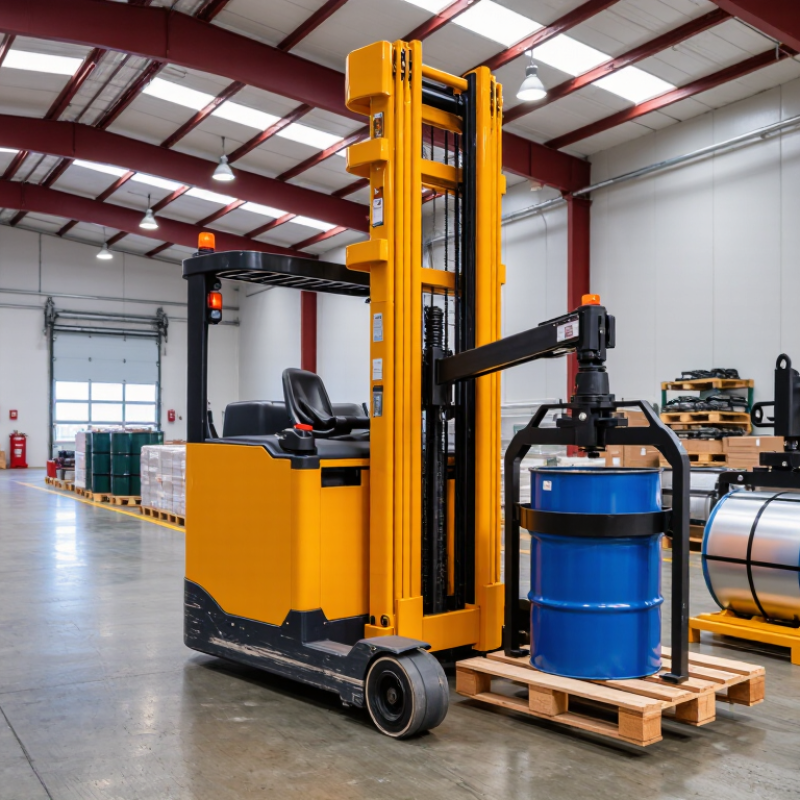
| Drum Handler | Lifts, transports, tilts, or rotates drums and barrels. | Chemical processing, manufacturing, waste handling, lubricants, coatings, and industrial storage. | Drum material, diameter, height, number of drums, maximum weight, gripping method, and rotation angle. | Confirm that the handler is designed for the drum rim or body. Hazardous-material operations may require additional site controls and approved handling procedures. | Identify drum type, filled weight, required orientation, spill-control needs, hydraulic requirements, and operating environment. |
| Rotator | Rotates loads around a horizontal axis, commonly through approximately 180 degrees. | Emptying bins, inverting containers, mold handling, foundries, food processing, and production lines. | Rated capacity, rotation range, rotation speed, carriage class, attachment weight, load center, and hydraulic flow. | The load must be positively secured before rotation. Capacity can be significantly reduced when the load center is extended or the attachment is used at an angle. | Confirm container dimensions, center of gravity, rotation direction, hydraulic circuit, visibility, and guarding requirements. |
| Load Backrest Extension | Helps stabilize tall or rearward-shifting loads on the forks. | Bagged goods, cartons, lumber, sheet goods, appliances, and stacked materials. | Height, width, carriage compatibility, load rating, visibility, and the type of loads being supported. | It should not obstruct the operator's view or interfere with the mast, load backrest, or overhead guard. It is not a substitute for properly securing unstable loads. | Check dimensions, mounting method, load profile, overhead clearance, and whether the attachment affects the approved capacity configuration. |
| Telescopic Forks | Extend hydraulically to reach loads at varying depths or to load and unload from one side. | Double-deep racking, container loading, trailers, block handling, and long-load support. | Closed and extended fork length, maximum extension, capacity at each position, fork section, carriage class, and hydraulic requirements. | Capacity may vary with fork extension. Load support must remain adequate across the fork length, and clearance should be checked before extending. | Define rack depth, container or trailer dimensions, required reach, load center at extension, and available hydraulic functions. |
| Work Platform | Provides a raised platform for authorized work at height when permitted by local rules and site procedures. | Maintenance, lighting, inventory inspection, facility repairs, and elevated access tasks. | Platform size, rated personnel and tool capacity, fork-pocket dimensions, guardrail height, toe-board design, and securing system. | Use is governed by local occupational-safety regulations and the manufacturer's instructions. The platform must be secured to the forks, and the truck must be operated on a stable surface. | Verify legal suitability, platform rating, attachment locking method, emergency procedures, operator training, and required fall protection. |
| Container or Bin Tipper | Tilts or empties material containers using a controlled tipping action. | Waste handling, recycling, production scrap, agriculture, food processing, and warehouse housekeeping. | Container dimensions, maximum load, tipping angle, retention system, emptying height, attachment weight, and hydraulic or manual operation. | Containers must be retained during tipping. The combined center of gravity can shift rapidly, so the rated capacity and floor conditions must be checked throughout the operation. | Provide bin type, loaded weight, tipping direction, discharge height, cycle frequency, and site floor conditions. |
| Snow Plow or Push Attachment | Pushes snow, light bulk material, or selected loose products across suitable surfaces. | Private yards, loading areas, industrial sites, agricultural facilities, and seasonal maintenance. | Blade width, blade height, mounting method, surface type, angle adjustment, attachment weight, and operating environment. | Use only on surfaces and materials approved for the attachment. The truck must have adequate traction, ground clearance, and visibility for the task. | Confirm surface conditions, material density, blade dimensions, seasonal storage needs, and local operating restrictions. |
| Universal selection rule: Before purchasing any forklift accessory, verify the forklift model and carriage class, attachment weight, rated capacity at the actual load center, hydraulic requirements, visibility, floor conditions, operator training, and applicable safety regulations. The accessory must be installed and used according to its technical documentation, and the forklift capacity information should be updated whenever the attachment changes the approved configuration. | |||||